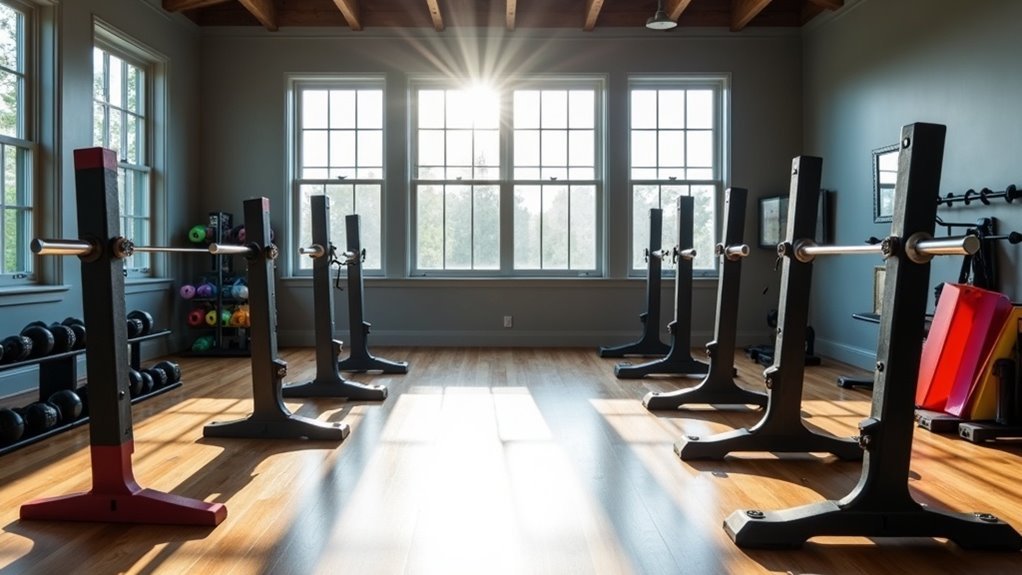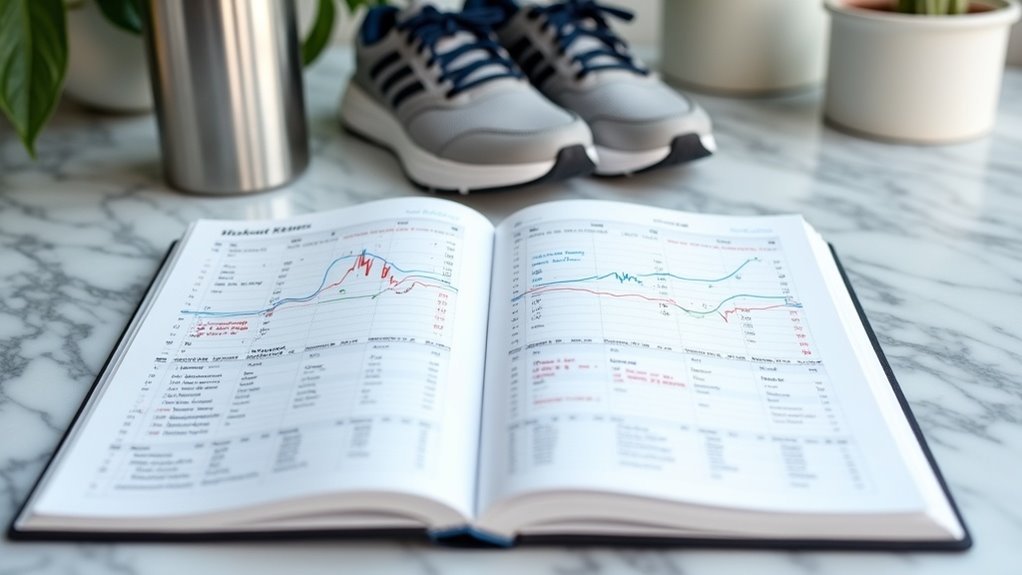
When tracking your home workout log, prioritize essential data points such as the date, sets, reps, and weights lifted to accurately measure your progress at home. Including performance notes and personal records can keep you motivated as you work towards your fitness goals. Additionally, monitoring body measurements, energy levels, and mood offers a comprehensive view of your fitness journey while exercising at home. Analyzing these metrics helps you identify strengths and weaknesses, allowing you to refine your home training strategies. These insights can significantly enhance your results and lead to smarter training choices as you pursue a healthier lifestyle from the comfort of your home gym.
Key Takeaways
- Track the date of each workout to establish consistency in your home fitness routine.
- Record weight lifted, sets, and repetitions to accurately measure your strength gains while using home gym equipment.
- Include performance notes to provide context on workout effectiveness and necessary adjustments for your at-home exercises.
- Highlight personal records to serve as motivational benchmarks for your progress in achieving fitness goals at home.
- Monitor body measurements and energy levels to assess your overall fitness and readiness for home workouts.
Essential Metrics to Track in Your Workout Log
When you track essential metrics in your home workout log, you create a powerful tool for monitoring your progress. Recording the date of each session establishes a timeline, revealing your consistency as you exercise at home.
Documenting the weight lifted alongside the number of sets and repetitions provides insights into your strength gains and training volume, which is crucial when using home gym equipment. This information helps you identify patterns and adjust your workouts accordingly.
Tracking the weight lifted, sets, and repetitions reveals strength gains and training volume, allowing for informed adjustments to your workouts.
Including performance notes adds context, helping you understand fluctuations in effectiveness in your home environment. Highlighting personal records serves as motivational benchmarks, encouraging future efforts and reinforcing your commitment to staying healthy.
Together, these metrics form a thorough view of your fitness journey, empowering you to share informed advice with others on their home gym experiences.
The Importance of Recording Sets, Reps, and Weights
Recording sets, reps, and weights is essential for tracking your progress while exercising at home, allowing you to clearly see your strength gains.
By analyzing this data, you can pinpoint your strengths and weaknesses, helping you tailor your home workout routine effectively.
Furthermore, this information empowers you to set realistic fitness goals that align with your capabilities and aspirations, whether you’re a man or a woman aiming for a healthier lifestyle through home gym equipment.
Track Progress Over Time
Tracking your sets, reps, and weights is essential for understanding your strength progression, especially when exercising at home. This measurable data reflects your improvements over time, helping you make the most of your home gym equipment.
By keeping track of your training data, you can identify performance trends and adjust your strategies accordingly, whether you’re using free weights, resistance bands, or bodyweight exercises. This accountability fosters motivation, making it easier to stay committed to your fitness goals from the comfort of your home.
Regularly reviewing your records highlights any inconsistencies or declines, prompting timely adjustments to your training regimen. An organized log also serves as a historical reference, allowing you to celebrate personal records and maintain focus on your ongoing fitness journey.
This ensures you consistently track progress over time while enjoying the benefits of home workouts.
Identify Strengths and Weaknesses
Understanding your strengths and weaknesses in your home gym workouts hinges on your ability to accurately record sets, reps, and weights. By tracking your exercises at home, you can pinpoint specific movements where you excel and those that need improvement.
This data allows you to adjust your training program, ensuring you focus on areas that require attention, even when working out in the comfort of your own space. Over time, this insight fosters accountability and motivation, as you see your progress reflected in personal records.
Consistently logging these metrics not only highlights your progress over time but also empowers you to set realistic goals, ultimately enhancing your overall strength and performance while staying healthy at home.
Set Realistic Fitness Goals
Setting realistic fitness goals is crucial for your success, especially when exercising at home. By tracking your workouts with sets, reps, and weights, you create a quantifiable benchmark to assess your strength progress.
This data helps you identify effective patterns and adjust your training frequency to fit your home workout routine. Documenting your workouts also helps prevent plateaus, ensuring you apply the progressive overload necessary for muscle growth, even with home gym equipment.
With a clear record, setting achievable short-term and long-term goals becomes easier, which can significantly boost your motivation. Regularly reviewing these data points allows for informed adjustments, optimizing your home workouts while minimizing the risk of injury.
Whether you’re a man or a woman, maintaining a structured approach to your fitness journey will help you stay healthy and reach your goals.
Incorporating Body Measurements for Holistic Progress
While it can be tempting to focus solely on the number on the scale, incorporating body measurements like body fat percentage and muscle mass provides a more comprehensive view of your fitness journey, especially when exercising at home.
Using methods such as Dexa scans or bioelectrical impedance can help you accurately track your workouts, revealing changes in body composition over time.
Regularly updating these body measurements—ideally on a monthly basis—can keep your motivation high and offer tangible evidence of your progress.
Tracking Energy Levels and Mood for Optimal Training
Integrating body measurements into your home fitness routine provides a solid foundation for tracking physical progress, but it’s equally important to monitor your energy levels and mood.
By recording these metrics, you can identify patterns that affect your training performance at home. Tracking energy fluctuations helps connect them with factors like sleep, nutrition, and stress, giving you a holistic view of your wellness while exercising in the comfort of your own space.
Recording metrics helps uncover patterns that influence your home training, linking energy levels to sleep, nutrition, and stress for a comprehensive wellness view.
Additionally, analyzing mood trends reveals triggers for poor performance days, allowing you to adjust your home workout intensity or focus proactively.
Consistent logging enhances self-awareness, tailoring your approach to align better with your unique psychological and physical states, ultimately leading to optimal results in your home gym experience.
Utilizing Technology for Enhanced Data Management
As you work to improve your home fitness journey, incorporating technology can significantly enhance your workout data management. By using digital apps to log your workouts, you can automate the tracking of essential metrics such as sets, reps, and weights, making it easy to access your progress.
Customizable spreadsheet applications can serve as your personalized gym management system, simplifying the process of data entry. Integrating wearable devices allows for real-time collection of additional metrics like heart rate and daily steps, further enriching your fitness data.
Plus, utilizing cloud-based platforms ensures that your workout logs are accessible from multiple devices, making it effortless to update and review your progress. These technological tools empower you to optimize your training insights, helping you achieve your fitness goals more effectively at home.
Analyzing Trends to Adjust Your Fitness Strategy
How effectively are you analyzing your home workout trends to refine your fitness strategy? To optimize your training at home, track key data points such as weight lifted, repetitions, and personal records using your home gym equipment.
Analyzing these trends reveals your muscular adaptations and overall progress in a convenient setting. Regularly monitor your workout frequency and intensity to identify performance patterns influenced by fatigue or external factors, especially in your home environment.
Additionally, recording changes in bodyweight and composition provides a comprehensive view of your fitness journey. Review past logs, including notes on your physical and mental state, to determine when to intensify your home workouts or incorporate recovery strategies for peak performance.
Adjust your approach based on these insights to stay healthy and motivated while exercising at home.