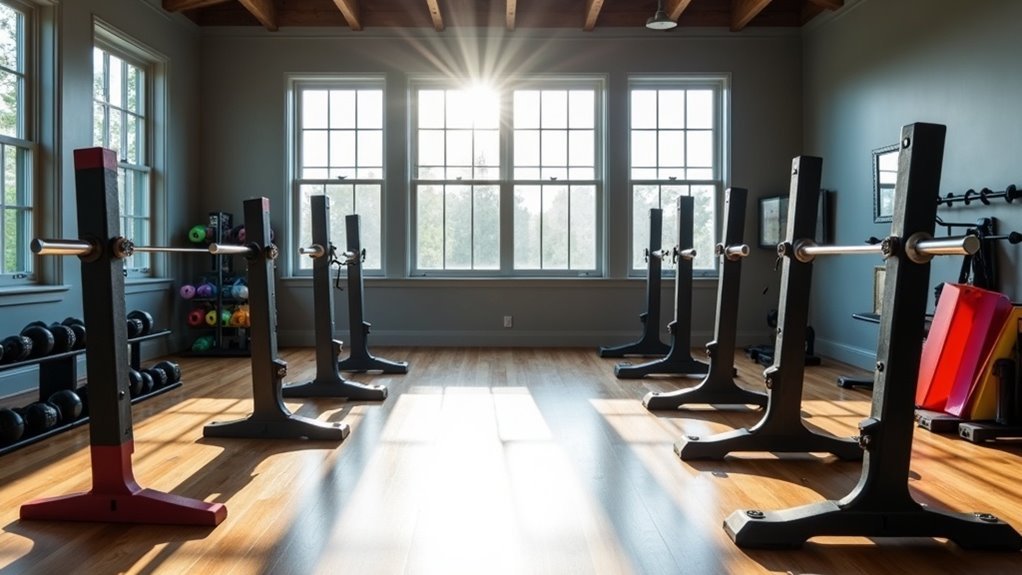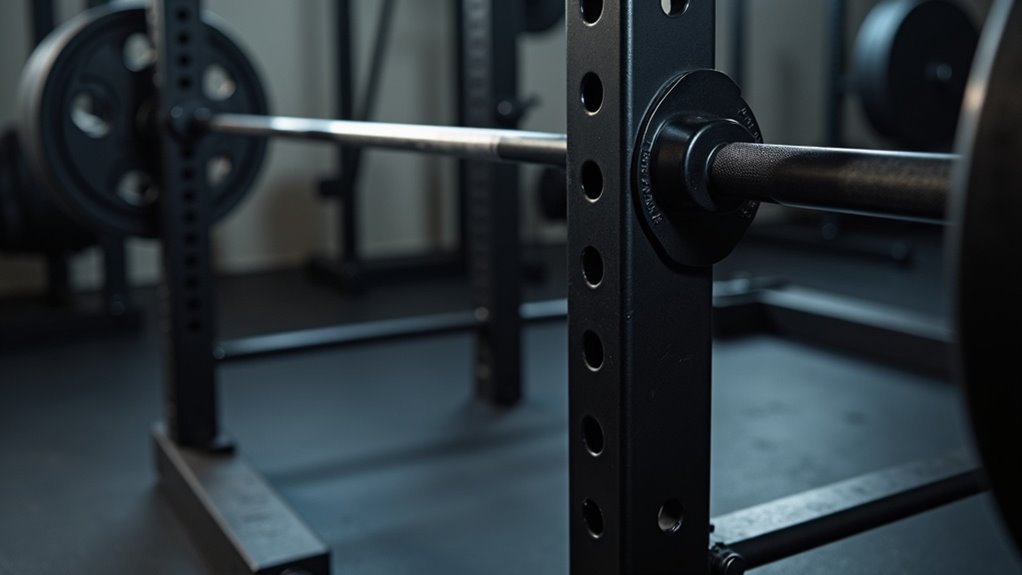
Power rack hole spacing significantly impacts setup precision for your home workouts. Standard 2-inch spacing provides a decent level of adjustability for various exercises, while Westside 1-inch spacing allows for more precise, fine-tuned adjustments tailored to your specific lifting needs. Proper alignment of safety pins and J-hooks is crucial for enhancing your lifting safety and performance, ultimately reducing the risk of injury. Misalignment can not only compromise your form but also lead to frustrating interruptions during your workout sessions. By understanding these details, you can optimize your home gym experience and take your fitness journey to the next level. There’s much more to discover about how to set up your home gym effectively!
Key Takeaways
- Hole spacing plays a crucial role in the adjustability of safety bars and J-hooks, which directly impacts workout safety and effectiveness for home gym enthusiasts.
- Standard 2-inch spacing offers general versatility for a variety of exercises, while the 1-inch Westside spacing allows for precise adjustments, particularly beneficial for those focused on powerlifting at home.
- Ensuring accurate hole alignment is vital to maintain proper lifting form, significantly reducing the risk of injury during workouts.
- Misalignment due to incorrect spacing can lead to frustration, ultimately affecting workout efficiency and safety during lifts for both men and women.
- Understanding hole spacing is essential for selecting compatible accessories, thereby enhancing the overall training experience and making it easier to adapt to individual fitness goals at home.
Understanding Power Rack Hole Spacing
When setting up your home gym power rack, understanding hole spacing is crucial for maximizing your workouts.
Standard power rack hole spacing is typically 2 inches apart, which provides good adjustability for various exercises. For those who want to fine-tune their benching setup, Westside spacing offers 1-inch increments, allowing for even more precise adjustments.
Measuring from the center of one hole to the next ensures accuracy in your setup. Selecting the right spacing is essential for properly positioning safety bars and J-hooks, directly affecting your lifting form and overall safety.
What Is Standard Power Rack Hole Spacing?
What’s standard power rack hole spacing? It generally refers to a 2-inch (50mm) distance between holes, measured center-to-center. This standard hole spacing provides ample adjustability, allowing you to position J-cups and safety pins optimally for exercises like squats.
Here are three essential points to consider:
- Compatibility: Understanding standard spacing ensures that your home gym equipment will work together seamlessly, making your setup more efficient.
- Flexibility: The 2-inch spacing offers the adjustability needed to accommodate the varying heights and preferences of most lifters, whether you’re a beginner or a seasoned athlete.
- Safety: Proper alignment of safety pins is crucial for enhancing lifting safety and performance, helping you feel more secure while working out at home.
Grasping this spacing is key to maximizing your workout efficiency and safety, enabling you to stay healthy and fit from the comfort of your home gym.
What Is Westside Hole Spacing?
While standard power rack hole spacing offers decent adjustability, Westside hole spacing enhances this with 1-inch (25mm) increments between holes.
This thoughtful design allows for precise adjustments, particularly beneficial in the benching area, giving you better control over J-cups and safety bars during heavy lifts.
Originating from Westside Barbell, this method is popular among powerlifters and home gym enthusiasts who seek to make micro-adjustments that can improve lifting form and safety.
Although it may come with higher manufacturing costs, integrating Westside hole spacing into your home gym setup can help you optimize your training routine and effectively break through performance plateaus, making it a worthwhile investment for anyone looking to stay healthy and fit at home.
Importance of Hole Spacing in Setup Precision
The importance of hole spacing in power racks is crucial for achieving optimal setup precision, especially for those dedicated to their home workout routines.
Proper hole spacing significantly influences both safety and performance, ensuring that your equipment aligns perfectly during lifts. Here are some key factors to consider:
- Adjustability: Standard 2-inch spacing allows for general positioning, making it suitable for various exercises. However, Westside’s 1-inch increments provide the flexibility needed for fine-tuning, catering to individual preferences and workout styles.
- Safety: Ensuring proper alignment is vital; misalignment can lead to compromised form and increase the risk of injury. With accurate hole spacing, you can maintain the correct posture throughout your lifts.
- Range of Motion: Precise adjustments enhance the effectiveness of your workouts, facilitating smoother transitions between exercises and maximizing your training results.
Training Style and Its Impact on Spacing Needs
Your training style plays a crucial role in determining the hole spacing you’ll need for optimal performance in your home gym.
If you’re into powerlifting, making precise adjustments in 1-inch increments can significantly enhance your safety and form during heavy lifts.
On the other hand, if your focus is on general fitness or accessory work, standard 2-inch spacing typically offers the versatility you need while ensuring safety.
This way, whether you’re a man or woman, you can tailor your home workout experience to fit your goals and preferences.
Powerlifting Precision Requirements
As powerlifting requires precision in every aspect of your home workout routine, selecting the right power rack hole spacing is essential for maximizing your performance. The right spacing can significantly influence your lifts.
Here are some key considerations:
- Micro-adjustments: With 1-inch hole spacing, you can achieve the perfect positioning of J-cups and safety bars, ensuring optimal stability during your lifts.
- Lift-off height: Closer spacing helps guarantee ideal shoulder positioning and core engagement during squats and presses, enhancing your overall form.
- Safety and efficiency: Proper hole spacing minimizes the risk of injury by aligning safety bars with your unique biomechanics, allowing you to train confidently at home.
Choosing the correct power rack hole spacing not only enhances your lifts but also supports your fitness goals, making your home gym experience more effective and enjoyable.
General Fitness Versatility
When considering general fitness versatility for your home gym, it’s important to understand how training style affects power rack hole spacing.
Standard 2-inch hole spacing is typically adequate for strength training, enabling you to perform a variety of exercises like the bench press and squats without the hassle of constant adjustments. This spacing supports a full range of motion, making it perfect for home gym setups where flexibility is key for both men and women looking to stay healthy through exercising at home.
While serious athletes may prefer Westside hole spacing for more precise adjustments, most fitness enthusiasts will find that broader adjustments satisfy their needs. This ensures a safe and effective workout experience with proper positioning for safety pins and J-cups.
Accessories and Compatibility Considerations
Understanding the compatibility of accessories with your power rack is essential for optimizing your home training experience.
Your training style can influence the necessary hole spacing, particularly for those focusing on strength training. Here are some key considerations to keep in mind when selecting your rack:
- Precision Needs: If you’re lifting heavy and require precise adjustments, opting for 1-inch spacing can be advantageous for fine-tuning your setup.
- Versatility: For those with a more varied workout routine, 2-inch spacing offers the flexibility needed for a wide range of accessory configurations.
- Future-Proofing: Think ahead about accessory compatibility to ensure your squat rack can adapt to your evolving fitness goals and training demands.
Common Challenges With Hole Spacing
When selecting a power rack for your home gym, it’s crucial to consider how hole spacing can affect the compatibility of accessories and your overall workout experience.
Misalignment with accessory fit can lead to frustration and unexpected costs, impacting your training routine. Inconsistent adjustment precision can also compromise your safety during lifts, making it vital to understand the significance of hole spacing in relation to your fitness goals.
Moreover, navigating confusing hole spacing standards can complicate your purchasing decisions, ultimately influencing your workout efficiency and safety at home.
Prioritizing the right equipment ensures you can focus on your health and fitness journey with confidence.
Misalignment With Accessory Fit
Misalignment with accessory fit can be a significant issue when setting up your home gym, impacting both your safety and workout efficiency.
To ensure a seamless experience, consider the following tips:
- Check Specifications: Always verify the hole spacing of your power rack and any accessories, such as J-cups and safety bars, to ensure a snug fit.
- Standard vs. Westside Spacing: Familiarize yourself with the differences between standard 2-inch hole spacing and Westside’s 1-inch spacing. This knowledge is crucial for making accurate height adjustments.
- Positioning for Safety: Make sure safety bars are properly positioned to offer reliable support during your lifts. Misalignment can increase the risk of injury, so double-check your setup.
Inconsistent Adjustment Precision
Inconsistent hole spacing can pose significant challenges for home gym enthusiasts striving for precision in their workouts. When safety pins and J-hooks don’t align properly, it can negatively impact your lifting form, increasing the risk of injury.
Standard hole spacing often limits your ability to make precise adjustments, making it difficult to find the ideal heights for various exercises. Furthermore, confusion between standard and Westside hole spacing can lead to compatibility issues with accessories, resulting in unnecessary returns and modifications.
Wider hole spacing can hinder your ability to adjust safely during heavy lifts, obstructing your range of motion. Therefore, clear product specifications are essential to ensure you select suitable equipment that meets your training needs and helps you stay healthy while exercising at home.
Complicated Purchase Decisions
Understanding the different hole spacing types is crucial for making informed purchasing decisions for your home gym equipment, particularly if you’re aiming to create a space that meets your fitness goals.
Before you make a purchase, consider the following factors:
- Adjustment Precision: Wider hole spacing can restrict your ability to make fine adjustments during lifts, which may compromise your safety.
- Compatibility: Ensure that any accessories you plan to use are compatible with the hole spacing of your equipment, as mismatches can lead to frustrating and costly returns.
- Safety Standards: Proper hole spacing is essential for minimizing injury risks, whether you’re working out at home or in a shared space.
How to Choose the Right Hole Spacing for Your Power Rack
When choosing a power rack for your home gym, it’s crucial to consider the hole spacing that aligns with your fitness goals. For those focused on general strength training, standard hole spacing (2 inches) offers sufficient adjustability to accommodate a variety of exercises.
If you’re more serious about powerlifting, you might want to opt for Westside hole spacing (1 inch) which allows for finer micro-adjustments that can enhance both safety and performance during your lifts.
For powerlifters, Westside hole spacing (1 inch) offers essential micro-adjustments for improved safety and lift performance.
Evaluate your training style: powerlifters benefit from the closer adjustments that Westside spacing provides, while casual fitness enthusiasts will likely find standard spacing adequate for their needs.
Additionally, always check the hole spacing specifications to ensure compatibility with accessories like J-cups and safety pins. This way, you can rest assured that your power rack will meet your future accessory requirements without the hassle of expensive replacements.
Investing in the right hole spacing will help you maximize your home workout experience and achieve your fitness objectives.
Measuring and Understanding Your Rack’s Hole Spacing
Accurately measuring your power rack’s hole spacing is essential for optimizing your workouts and ensuring that all your accessories are compatible.
Follow these steps to make sure you’re evaluating the spacing correctly:
- Use a tape measure: Measure the distance from the center of one hole to the center of the next.
- Identify standard vs. Westside spacing: Standard spacing typically features 2 inches (50 mm) increments, while Westside spacing offers 1-inch (25 mm) increments for more precise adjustments.
- Confirm accessory fit: Ensure that your accessories, such as J-cups and safety pins, align with your rack’s hole spacing. This is crucial for proper adjustability during various exercises, contributing to both safety and effectiveness in your home workouts.